> ## Documentation Index
> Fetch the complete documentation index at: https://the-bingo-fi-a4951ed8.mintlify.site/llms.txt
> Use this file to discover all available pages before exploring further.
# Economy & Business Model
> Revenue sources, on-chain dynamic pricing, seeded rarity tiers, and the season model
TheBingoFi's entire business model is the sale of Skill and Skin NFTs. There is no other revenue mechanism, and, as covered in [Solution](/solution), no stake, pot, pool, or token anywhere in the product.
## Revenue sources
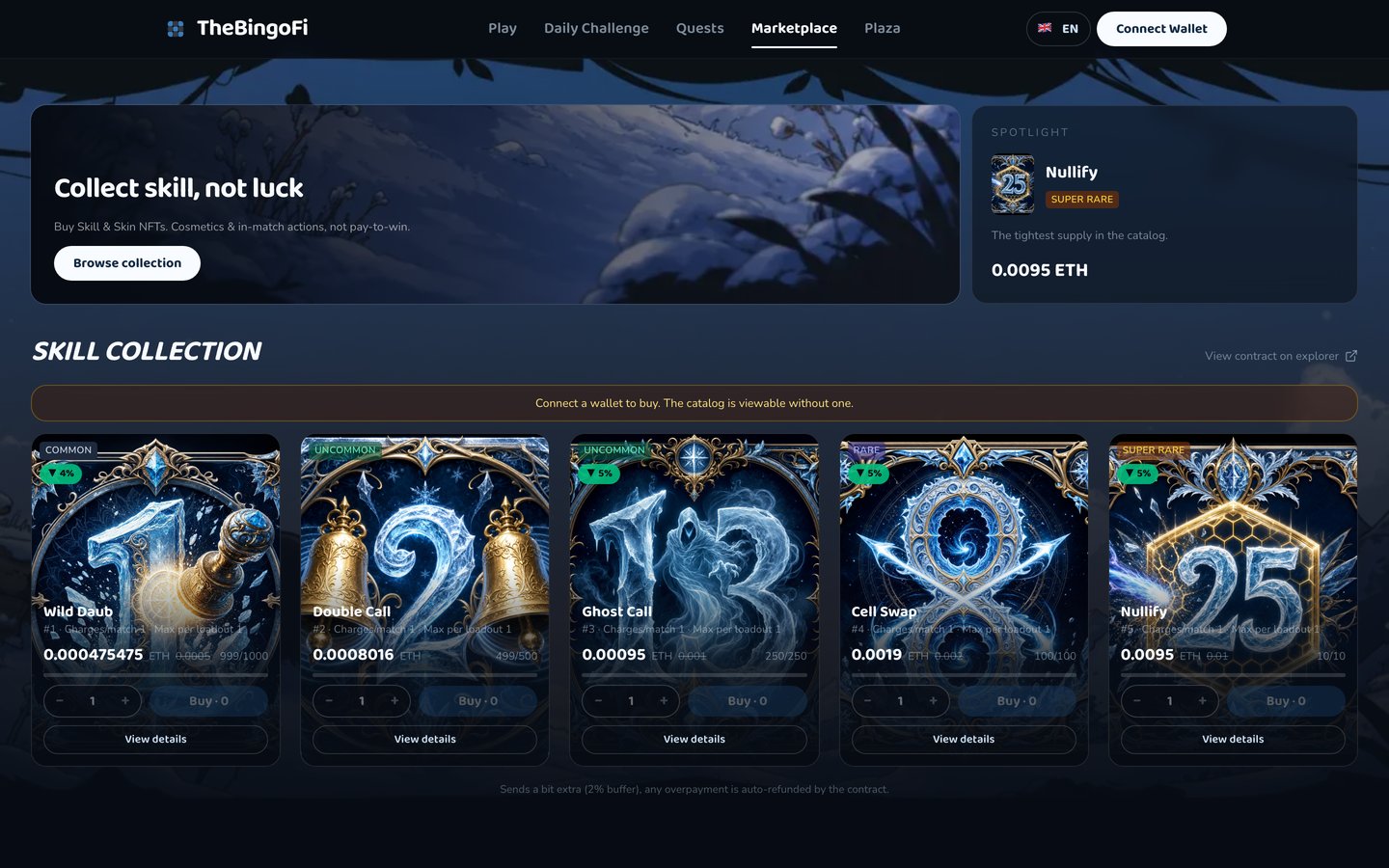
Players buy skills/skins directly from the platform through `Marketplace.buy()`, which mints the NFT straight to the buyer. Price is set by the on-chain dynamic pricing model below, not a fixed number.
Any resale on a third-party NFT marketplace pays a **5% royalty** (500 basis points) back to the platform, via the `SkillCollection` contract's EIP-2981 default royalty.
 ## Dynamic pricing: scarcity ramp + demand decay
Primary sale price is **not a static number**. It's computed on-chain, on every call, from two forces pulling in opposite directions: the closer a skill gets to selling out, the more expensive it gets; the longer a skill goes without a sale, the cheaper it gets. This is implemented in `Marketplace.sol` and is live on GIWA Sepolia today.
```mermaid theme={null}
flowchart LR
BP["basePrice"]
Minted["minted / maxSupply"]
Time["time since lastPurchaseAt"]
Minted -->|scarcity ramp: more minted, higher premium, capped at +100%| SP["scarcityPremium"]
Time -->|demand decay: longer idle, bigger discount, capped at -50%| DB["discountBps"]
BP --> Final
SP --> Final
DB --> Final
Final["priceOf =
## Dynamic pricing: scarcity ramp + demand decay
Primary sale price is **not a static number**. It's computed on-chain, on every call, from two forces pulling in opposite directions: the closer a skill gets to selling out, the more expensive it gets; the longer a skill goes without a sale, the cheaper it gets. This is implemented in `Marketplace.sol` and is live on GIWA Sepolia today.
```mermaid theme={null}
flowchart LR
BP["basePrice"]
Minted["minted / maxSupply"]
Time["time since lastPurchaseAt"]
Minted -->|scarcity ramp: more minted, higher premium, capped at +100%| SP["scarcityPremium"]
Time -->|demand decay: longer idle, bigger discount, capped at -50%| DB["discountBps"]
BP --> Final
SP --> Final
DB --> Final
Final["priceOf =
(basePrice + scarcityPremium) * (10000 - discountBps) / 10000"]
```
### Scarcity ramp
As more units of a skill are minted, its price ramps up linearly, reaching the maximum premium exactly when the sale is fully sold out:
```
scarcityPremium = basePrice * scarcityBps * minted / maxSupply / 10000
```
With the default global parameter `scarcityBps = 10000`, that means **up to +100% over `basePrice`** once `minted == maxSupply`.
### Demand decay
If a skill goes untouched, its price steps down over time, capped at a maximum discount, and reset to zero the instant someone buys:
```
discountBps = min(maxDiscountBps, (block.timestamp - lastPurchaseAt) / decayInterval * decayStepBps)
```
Default parameters: `decayInterval = 1 day`, `decayStepBps = 500` (5% per full day of inactivity), `maxDiscountBps = 5000` (50% ceiling). Every purchase resets `lastPurchaseAt`, which resets the discount to 0.
### Final unit price
```
priceOf(skillId) = (basePrice + scarcityPremium) * (10000 - discountBps) / 10000
```
`Marketplace.priceOf(skillId)` is the **only** correct source for a purchase quote: `basePrice` alone is never enough, since real price moves with every mint and with elapsed time. `buy(skillId, amount)` computes `unitPrice` once from state at execution time (not re-priced mid-multi-unit-purchase), and any `msg.value` overpayment is automatically refunded in the same transaction (checks-effects-interactions; if the refund itself fails, the whole transaction reverts, so buyer funds are never stranded).
All four parameters above (`scarcityBps`, `decayInterval`, `decayStepBps`, `maxDiscountBps`) are one global set, tunable at any time via `setPricingParams(...)` (admin-only). **No redeploy required.**
These are the contract's shipped default values. They're a single global set applied to every sale and can be retuned by the platform at any time.
### Worked examples (default parameters)
`basePrice = 0.0005 ETH`, `maxSupply = 1000`
| Minted | Scarcity premium | `priceOf` |
| --------------- | ---------------- | ----------- |
| 0 (fresh) | +0% | 0.0005 ETH |
| 500 (50% sold) | +50% | 0.00075 ETH |
| 1000 (sold out) | +100% | 0.001 ETH |
`basePrice = 0.01 ETH`, `maxSupply = 10`
| Minted | Scarcity premium | `priceOf` |
| ------------- | ---------------- | --------- |
| 0 (fresh) | +0% | 0.01 ETH |
| 9 (90% sold) | +90% | 0.019 ETH |
| 10 (sold out) | +100% | 0.02 ETH |
Because `minted / maxSupply` moves in much bigger steps when `maxSupply` is only 10, a low-supply skill like Nullify reaches full scarcity premium far faster, unit for unit, than a high-supply skill like Wild Daub.
Any skill, 3 full days since the last purchase, `minted = 0` (no scarcity premium in play):
`discountBps = min(5000, 3 * 500) = 1500`, which is **15% off** base price.
For Wild Daub (`basePrice = 0.0005 ETH`): `priceOf = 0.0005 * (10000 - 1500) / 10000 = 0.000425 ETH`.
`priceOf(skillId)` can still be queried after a sale sells out (useful for a "last price" UI reference). Only `buy()` itself reverts (`SoldOut`) once `minted == maxSupply`.
## Rarity tiers (seeded catalog)
The 5 launch skills were seeded on GIWA Sepolia with deliberately staggered supply and base price, to demonstrate the scarcity tiers described above:
| ID | Skill | `effectType` | Max supply | Base price |
| -- | ----------- | ------------- | ---------- | --------------------- |
| 1 | Wild Daub | `WILD_DAUB` | 1000 | 0.0005 ETH |
| 2 | Double Call | `DOUBLE_CALL` | 500 | 0.0008 ETH |
| 3 | Ghost Call | `GHOST_CALL` | 250 | 0.001 ETH |
| 4 | Cell Swap | `CELL_SWAP` | 100 | 0.002 ETH |
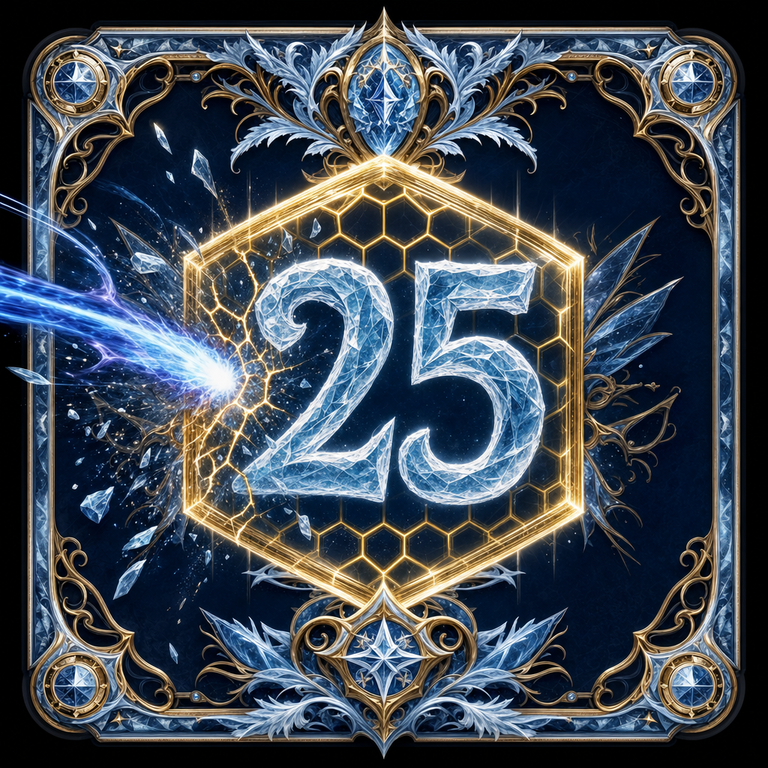
| 5 | Nullify | `NULLIFY` | 10 | 0.01 ETH (super rare) |
Lower max supply pairs with a higher starting base price *and* a faster climb to the full scarcity premium: the two mechanisms reinforce each other for the rarest items.
 ## Season model
Each season, the platform can release a fresh batch of skills through the `SkillFactory`. **`createSkill(SkillDef, maxSupply, price)` is a single transaction** that simultaneously registers the skill's definition in the `SkillRegistry` *and* opens its sale in the `Marketplace`. No new contract deployment, no upgrade, is needed to ship new content each season. See [Smart Contracts](/smart-contracts) for the full release flow.
## Free-to-play stays competitive
Casual mode carries **no skills at all**. It's identical for every player regardless of wallet or NFT ownership, so a player who never buys anything is never at a competitive disadvantage in that mode. In `standard`-mode rooms, a player who hasn't set a loadout simply plays without skills, same as Casual, rather than being blocked from the room.
The original game design (`CONCEPT.md`) also describes a **non-NFT, non-tradeable "starter" skill loan** to let brand-new players try the skill layer before ever touching a wallet. That mechanism is a design idea, not something implemented in the live server today.
## Season model
Each season, the platform can release a fresh batch of skills through the `SkillFactory`. **`createSkill(SkillDef, maxSupply, price)` is a single transaction** that simultaneously registers the skill's definition in the `SkillRegistry` *and* opens its sale in the `Marketplace`. No new contract deployment, no upgrade, is needed to ship new content each season. See [Smart Contracts](/smart-contracts) for the full release flow.
## Free-to-play stays competitive
Casual mode carries **no skills at all**. It's identical for every player regardless of wallet or NFT ownership, so a player who never buys anything is never at a competitive disadvantage in that mode. In `standard`-mode rooms, a player who hasn't set a loadout simply plays without skills, same as Casual, rather than being blocked from the room.
The original game design (`CONCEPT.md`) also describes a **non-NFT, non-tradeable "starter" skill loan** to let brand-new players try the skill layer before ever touching a wallet. That mechanism is a design idea, not something implemented in the live server today.